
Meeting minutes:
Present were: Frank, Roland, Bruno, Christian, Ian, Erik
Testsuites * AHFinderDirect/AEILocalInterp: Carpet/mercurial with full grid gives identical results on 1 or 2 processors, PUGH with bitant grid does not. This points to PUGHInterp to be th culprit. However Ian sees differences when using Multipole and Carpet as well (for 32 processors). This points to the symmetry handling in AEILocalInterp being the culprit. * we will use an EVO meeting to coordinate fixing this bug (see Frank's email from earlier today) * PPM related failures: might be that tolerance of testsuites is too low * will release no later than Friday even if these two bugs remain since they were already present in the current release * ML failures: seem to be tolerance related, raising the tolerance should fix this
Citations * will sent email to users and Cactus mailing lists to get input from thorn authors as to which papers to cite * will prepare html version of bibtex file for website
Yours, Roland

On Mon, Nov 15, 2010 at 11:46 AM, Roland Haas roland.haas@physics.gatech.edu wrote:
Meeting minutes:
Present were: Frank, Roland, Bruno, Christian, Ian, Erik
Testsuites
- AHFinderDirect/AEILocalInterp: Carpet/mercurial with full grid gives
identical results on 1 or 2 processors, PUGH with bitant grid does not. This points to PUGHInterp to be th culprit. However Ian sees differences when using Multipole and Carpet as well (for 32 processors). This points to the symmetry handling in AEILocalInterp being the culprit.
I have looked at the interpolation coordinates that AHFinderDirect requests from the interpolator, and how they change during the nonlinear elliptic solve. I have used PUGH, and compared runs on 1 and 2 processes.
The first three times the interpolator is called, the coordinates are almost identical, differing by round-off only (1e-16). This round-off error exists only in the domain of the second process. It seems to be cause by the floating-point representation of the lower domain boundary -0.4, which cannot be represented exactly, thus many coordinate values differ by round-off.
When the interpolator is called the fourth time, there are suddenly substantial differences of the order of 1e-7 everywhere in the domain. My best guess this is that the linear solver, which uses an ILU decomposition as preconditioner (I believe) and thus makes some discrete choices depending on its input, yields a different approximation because of the abovementioned floating-point differences.
This is also evident in the output of AHFinderDirect, if one increases the precision. The trial surfaces' Theta value (which depends on the interpolation result) begins to differ significantly in the same iteration in which the average surface radius (which depends on the interpolator input) begins to differ as well. That is, the interpolation result only differs if the interpolator input differs as well. (Note that there are two interpolator calls per iteration; this is used to evaluate the radial dependence of the Jacobian.)
grep 'proc 0/horizon 1' np?/Kerr*.out | awk '{ print $6,$7,$8; }'
1 process:
1 r_grid=1.8888370318372081 ||Theta||=0.58245864115033152 2 r_grid=1.8382954223001324 ||Theta||=0.41707953161957556 3 r_grid=1.7988326341366765 ||Theta||=0.19206874617879019 4 r_grid=1.7970186650813291 ||Theta||=0.020839031289570303 5 r_grid=1.8003073662257811 ||Theta||=0.00049321965075897409 6 r_grid=1.8003202072919120 ||Theta||=5.0676410161959451e-08 7 r_grid=1.8003202078276501 ||Theta||=3.8071282237872595e-13
2 processes:
1 r_grid=1.8888370318372081 ||Theta||=0.5824586411503323 2 r_grid=1.8382954098754503 ||Theta||=0.41707944199389968 3 r_grid=1.7988327249094958 ||Theta||=0.19206838061444106 4 r_grid=1.7970189739199420 ||Theta||=0.020838947150236913 5 r_grid=1.8003076389626189 ||Theta||=0.00049321768953301467 6 r_grid=1.8003204797819821 ||Theta||=5.0679888046606392e-08 7 r_grid=1.8003204803171862 ||Theta||=3.8437655835998896e-13
In conclusion, I could not find any problem with AHFinderDirect, AEILocalInterp, CarpetInterp, or PUGHInterp. It may in principle be good to have more thorough test suites for these, but this would be independent of the horizon finding problem discussed here.
-erik

Hi,
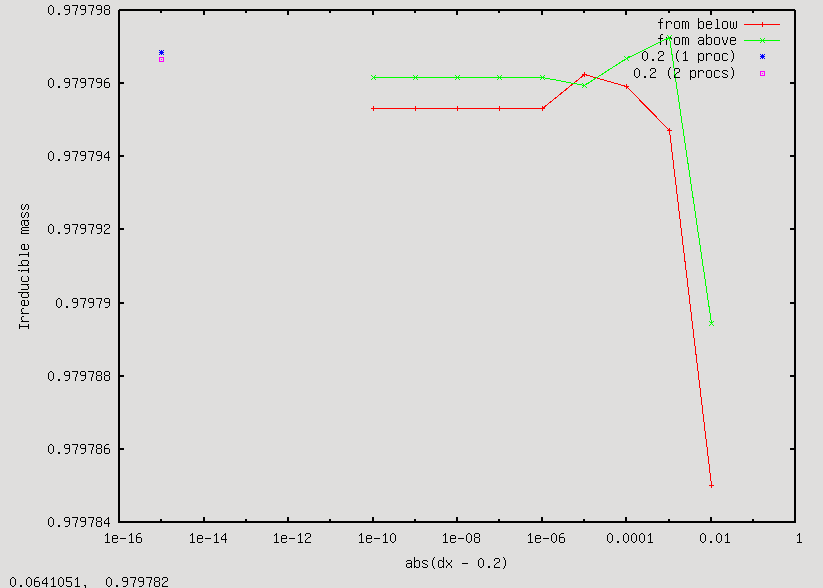
I looked into this a bit more today. While I tried to check convergence I noticed that if I increased the resolution on the grid (e.g. from 0.2 to 0.1) I got identical results on 1 and 2 processors. Playing around with the resolution I wasn't able to find another case where I got different results (though this is no guarantee that such cases do not exist). To investigate this further I examined how the irreducible mass depends on the grid resolution, especially in the neighbourhood of 0.2. The attached plot shows the result of that investigation. I plot the irreducible mass as function of abs(dx-0.2). The red curve approaches 0.2 from below (0.19, 0.199 and so on) and the green curve approaches from above (0.21, 0.201 and so on). I have artificially added the results for 1 and 2 processors for dx=0.2 at the x-coordinate 1e-15 in the plot in order to show the magnitude of the difference. I repeat, that in all the cases where the resolution is different from 0.2 I do get the same result on 1 or 2 processors (to within the testsuite tolerance). As you can see there are clear limits when approaching dx=0.2 from below or above. However, the limits are not the same and also differ from the value at dx=0.2. In addition the difference between the limits is larger than the difference between the 1 and 2 processor result at dx=0.2. I must admit that I don't understand why dx=0.2 should be so special compared to all the other resolutions I've tried.
If we want to have some AHFinderDirect testsuites that give identical results on 1 and 2 processors one solution seem to be to simply change the grid resolution in the current tests and regenerate the output.
I have just checked that modifying the resolution of the test:
Kerr-definition-mean-curvature.par
from 0.2 to 0.19 also results in identical results on 1 and 2 processors.
While this seems to solve the testsuite problem, it still leaves open the question as to why these particular tests fail when the resolution is exactly 0.2.
Cheers,
Peter
On Mon, 15 Nov 2010, Erik Schnetter wrote:
On Mon, Nov 15, 2010 at 11:46 AM, Roland Haas roland.haas@physics.gatech.edu wrote:
Meeting minutes:
Present were: Frank, Roland, Bruno, Christian, Ian, Erik
Testsuites
- AHFinderDirect/AEILocalInterp: Carpet/mercurial with full grid gives
identical results on 1 or 2 processors, PUGH with bitant grid does not. This points to PUGHInterp to be th culprit. However Ian sees differences when using Multipole and Carpet as well (for 32 processors). This points to the symmetry handling in AEILocalInterp being the culprit.
I have looked at the interpolation coordinates that AHFinderDirect requests from the interpolator, and how they change during the nonlinear elliptic solve. I have used PUGH, and compared runs on 1 and 2 processes.
The first three times the interpolator is called, the coordinates are almost identical, differing by round-off only (1e-16). This round-off error exists only in the domain of the second process. It seems to be cause by the floating-point representation of the lower domain boundary -0.4, which cannot be represented exactly, thus many coordinate values differ by round-off.
When the interpolator is called the fourth time, there are suddenly substantial differences of the order of 1e-7 everywhere in the domain. My best guess this is that the linear solver, which uses an ILU decomposition as preconditioner (I believe) and thus makes some discrete choices depending on its input, yields a different approximation because of the abovementioned floating-point differences.
This is also evident in the output of AHFinderDirect, if one increases the precision. The trial surfaces' Theta value (which depends on the interpolation result) begins to differ significantly in the same iteration in which the average surface radius (which depends on the interpolator input) begins to differ as well. That is, the interpolation result only differs if the interpolator input differs as well. (Note that there are two interpolator calls per iteration; this is used to evaluate the radial dependence of the Jacobian.)
grep 'proc 0/horizon 1' np?/Kerr*.out | awk '{ print $6,$7,$8; }'
1 process:
1 r_grid=1.8888370318372081 ||Theta||=0.58245864115033152 2 r_grid=1.8382954223001324 ||Theta||=0.41707953161957556 3 r_grid=1.7988326341366765 ||Theta||=0.19206874617879019 4 r_grid=1.7970186650813291 ||Theta||=0.020839031289570303 5 r_grid=1.8003073662257811 ||Theta||=0.00049321965075897409 6 r_grid=1.8003202072919120 ||Theta||=5.0676410161959451e-08 7 r_grid=1.8003202078276501 ||Theta||=3.8071282237872595e-13
2 processes:
1 r_grid=1.8888370318372081 ||Theta||=0.5824586411503323 2 r_grid=1.8382954098754503 ||Theta||=0.41707944199389968 3 r_grid=1.7988327249094958 ||Theta||=0.19206838061444106 4 r_grid=1.7970189739199420 ||Theta||=0.020838947150236913 5 r_grid=1.8003076389626189 ||Theta||=0.00049321768953301467 6 r_grid=1.8003204797819821 ||Theta||=5.0679888046606392e-08 7 r_grid=1.8003204803171862 ||Theta||=3.8437655835998896e-13
In conclusion, I could not find any problem with AHFinderDirect, AEILocalInterp, CarpetInterp, or PUGHInterp. It may in principle be good to have more thorough test suites for these, but this would be independent of the horizon finding problem discussed here.
-erik
-- Erik Schnetter schnetter@cct.lsu.edu http://www.cct.lsu.edu/~eschnett/ _______________________________________________ Users mailing list Users@einsteintoolkit.org http://lists.einsteintoolkit.org/mailman/listinfo/users

On 15 Nov 2010, at 17:46, Roland Haas wrote:
Testsuites
- AHFinderDirect/AEILocalInterp: Carpet/mercurial with full grid
gives identical results on 1 or 2 processors, PUGH with bitant grid does not. This points to PUGHInterp to be th culprit.
However Ian sees differences when using Multipole and Carpet as well (for 32 processors). This points to the symmetry handling in AEILocalInterp being the culprit.
Erik found the source of the Multipole problem, and it was unrelated. The problem was that Multipole uses Hermite polynomial interpolation by default which requires 3 ghost zones, but the tests were being run with 2. This leads to AEILocalInterp not having enough points to interpolate with a centered stencil when close to an interprocessor boundary. In such cases, AEILocalInterp silently off-centres the interpolation stencil, leading to a different interpolation error, though still of the correct order.
I have modified Multipole so that it disables this off-centering by default; this should allow such problems to be identified more easily. I have also modified the test suites to use 3 ghost zones, and they now pass on 32 processes, in addition to the 1 and 2 process tests that were passing before.
users@lists.einsteintoolkit.org
-
 Erik Schnetter
 -
 Ian Hinder
 -
 Peter Diener
 -
 Roland Haas