
Dear all,
A short update on this week's work, and two figures I would be glad to have your opinion on.
This week - The review items (CCL READS/WRITES, checkpointing of the particle state, per-level AMR sampling, time interpolation with d_t g, and robust strong-curvature sampling) are now in the repo, together with the completed paper (English + Chinese) and the parameter files: https://github.com/wylyhzh/Geodesic - New: robustness on the non-stationary GW150914 BBH background (3-level AMR, 2048 Cactus steps, 100 particles). All four samplers (aei, carpet, local27, local27lin) show no loss, no NaN, and pairwise agreement of order 8e-3.
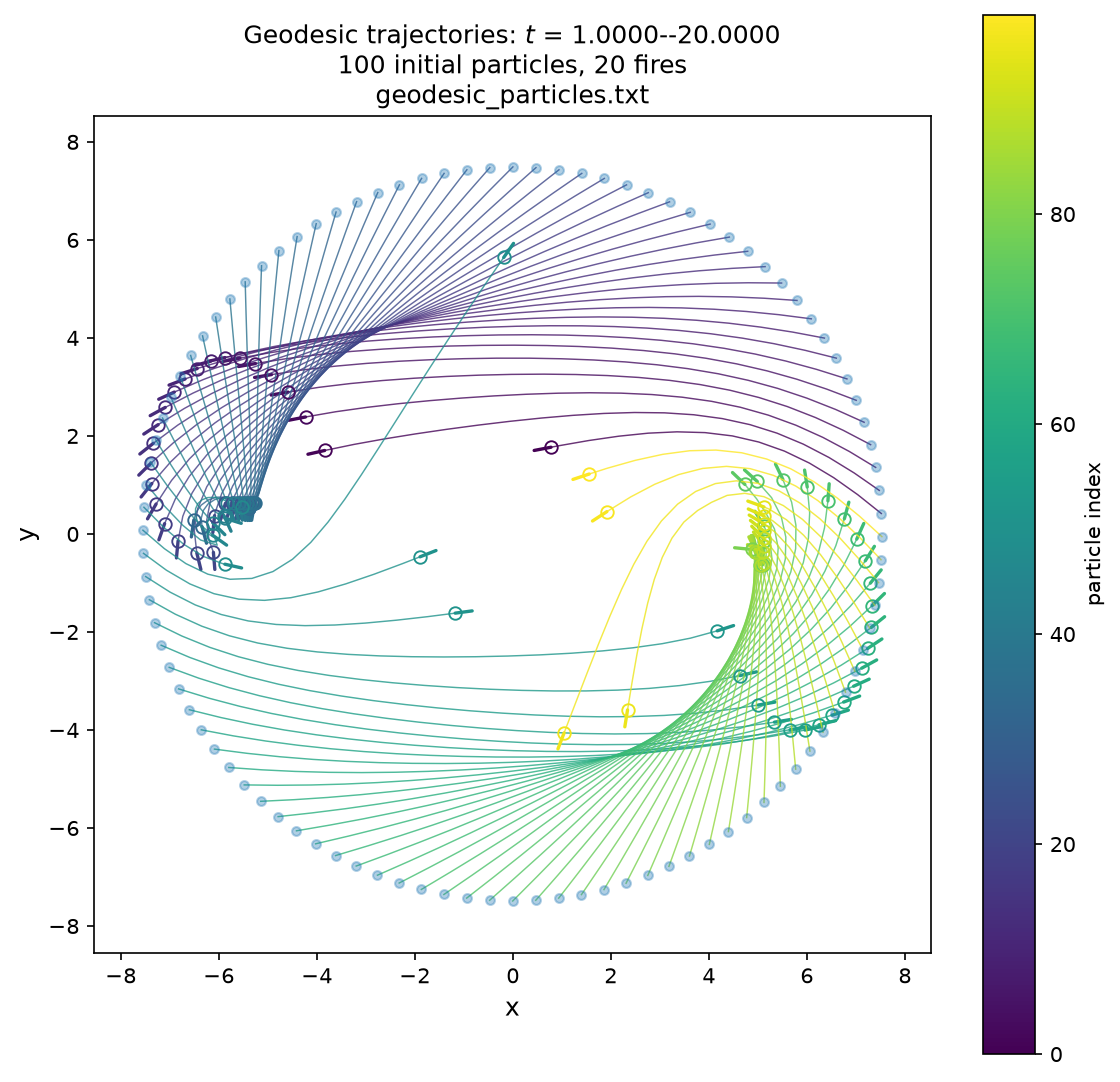
Two attached figures (same GW150914 BBH background, 100-particle ring at r = 8M with a strong inward radial velocity added to the circular-orbit IC): 1. aei sampler: 50 of 100 particles dropped (442 NaN rows). 2. local27lin sampler, same IC: 22 dropped (168 NaN rows). With the standard (circular) ring IC the drops are aei = 6, local27lin = 22; the extra drops in the aei strong-inflow run are where the strong-curvature sampling path is most stressed.
Two questions - Any advice on the thorn's path to ET inclusion? - How should dropped particles be presented in such plots? I currently filter NaN rows when plotting; I am also considering marking each particle's last valid position, since the drops are physical plunges, not numerical failures.
Best regards, Yuhua Li
users@lists.einsteintoolkit.org
-
 Yuhua Li