
Dear all, my name is Lorenzo Cipriani, PhD student at the University of L'Aquila.
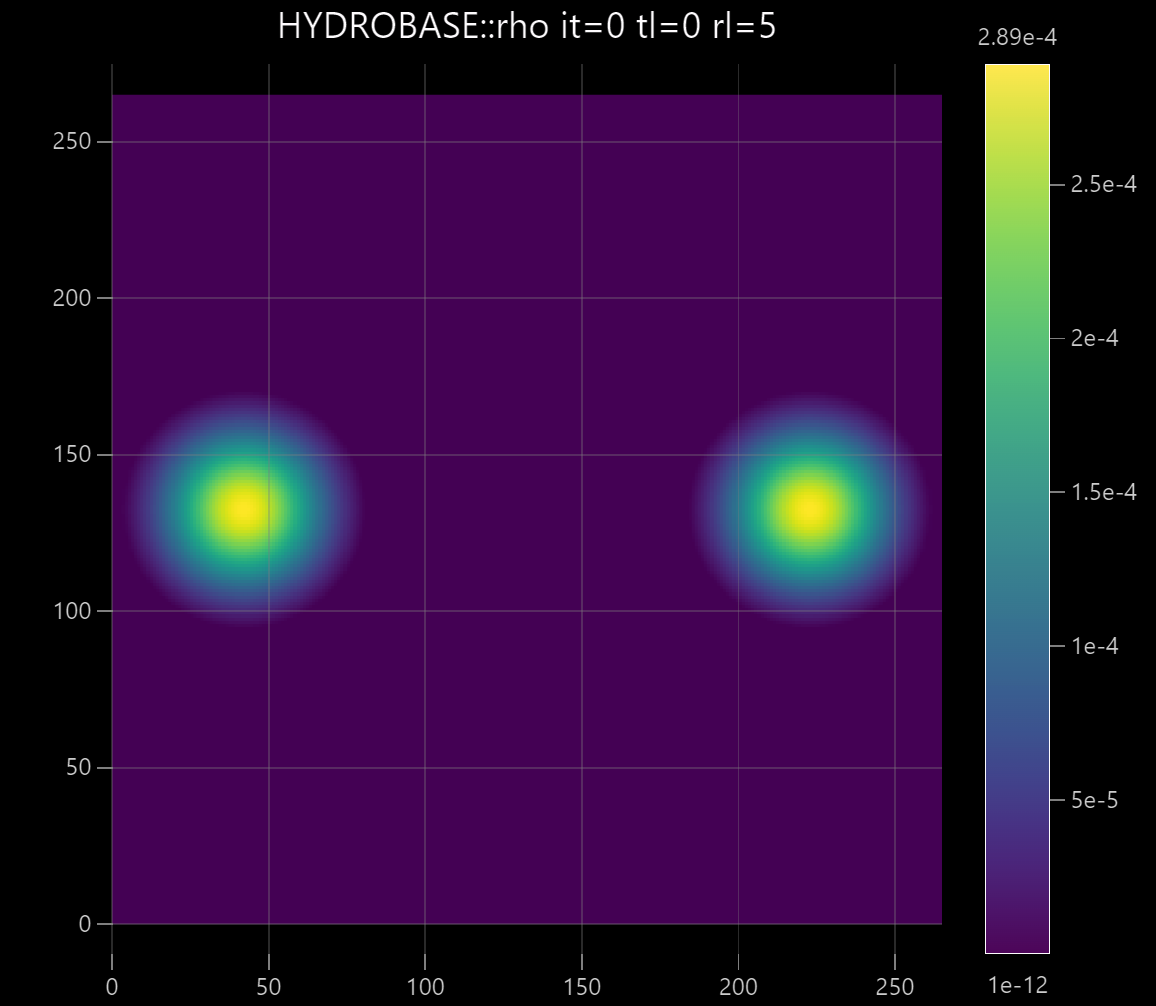
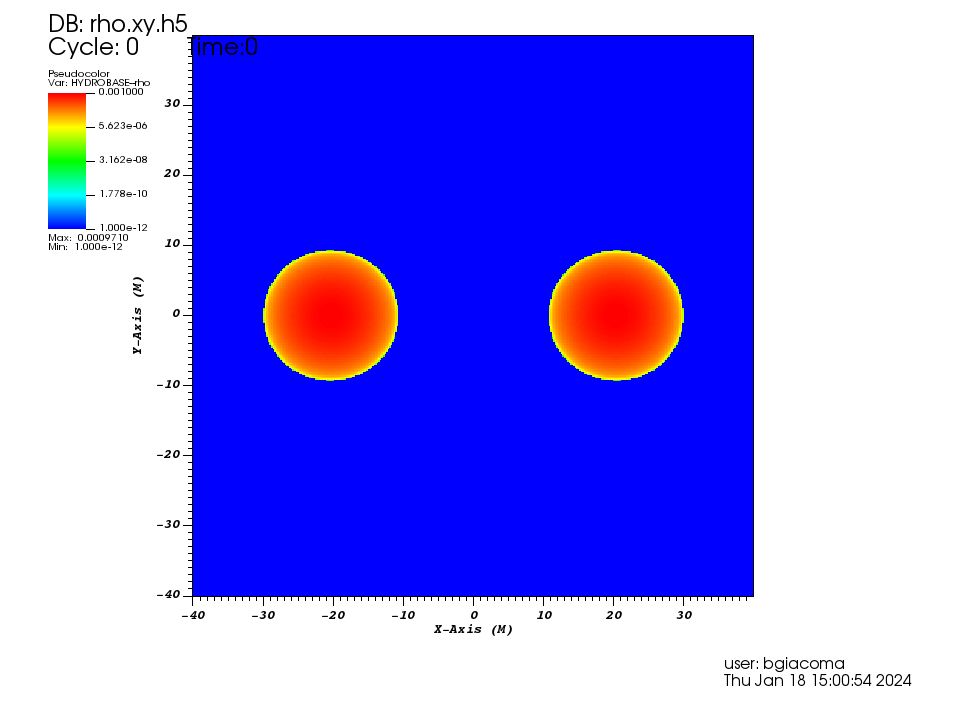
My goal is to simulate a BNS merger using initial data computed from Lorene and evolved according to the parameter file I have attached. Cactus reads the initial data correctly, as you can see in the image "rhoxy_initial.png" but, immediately after, the stars practically disappear from the grid, perfectly cut away (see image "rhoxy_it4.png").
Does anybody have a hint on what might be happening? I have never encountered a behavior like this.
Thank you for your assistance, best regards, Lorenzo
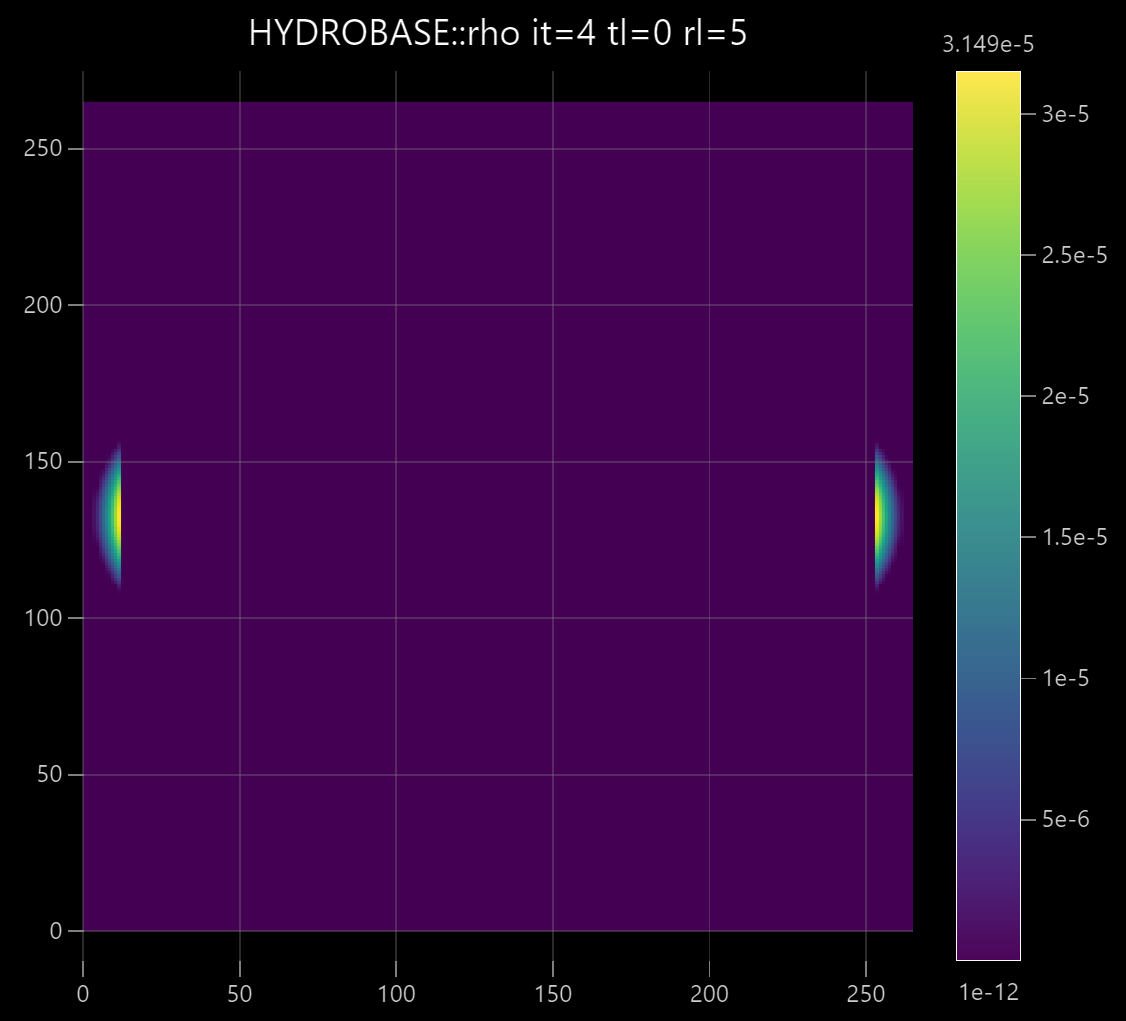

Lorenzo, the perfectly cut away may be due to the fact that you may have had failures in con2prim on the finest levels (and maybe points got set to atmosphere), but the coarser levels were not computed yet. Your standard output reports indeed errors in c2p. You use 6 refinement levels and therefore all levels are at the same time every 2^(6-1)=32 iterations. At iteration 4 only the 3 most inner levels would be at the same.
I would increase the resolution since your finest grid is using a resolution of 12/2^5 = 0.375 so that you have a resolution of at least 0.24 on the finest level (level 5) and check if this solves the problem.
Cheers, Bruno
Il giorno mer 17 gen 2024 alle ore 15:41 Lorenzo Cipriani < lorenzo.cipriani@graduate.univaq.it> ha scritto:
Dear all, my name is Lorenzo Cipriani, PhD student at the University of L'Aquila.
My goal is to simulate a BNS merger using initial data computed from Lorene and evolved according to the parameter file I have attached. Cactus reads the initial data correctly, as you can see in the image "rhoxy_initial.png" but, immediately after, the stars practically disappear from the grid, perfectly cut away (see image "rhoxy_it4.png").
Does anybody have a hint on what might be happening? I have never encountered a behavior like this.
Thank you for your assistance, best regards, Lorenzo _______________________________________________ Users mailing list Users@einsteintoolkit.org http://lists.einsteintoolkit.org/mailman/listinfo/users
Dear Bruno,
I increased the resolution so that the finest level now has a resolution of 7/2^5 = 0.21875 using a smaller coarse grid, but the output remains unchanged.
Please let me know your thoughts on this!
Best, Lorenzo
________________________________ Da: Bruno Giacomazzo bruno.giacomazzo@unimib.it Inviato: mercoledì 17 gennaio 2024 16:44 A: Lorenzo Cipriani lorenzo.cipriani@graduate.univaq.it Cc: users@einsteintoolkit.org users@einsteintoolkit.org Oggetto: Re: [Users] Star disappear from grid
Lorenzo, the perfectly cut away may be due to the fact that you may have had failures in con2prim on the finest levels (and maybe points got set to atmosphere), but the coarser levels were not computed yet. Your standard output reports indeed errors in c2p. You use 6 refinement levels and therefore all levels are at the same time every 2^(6-1)=32 iterations. At iteration 4 only the 3 most inner levels would be at the same.
I would increase the resolution since your finest grid is using a resolution of 12/2^5 = 0.375 so that you have a resolution of at least 0.24 on the finest level (level 5) and check if this solves the problem.
Cheers, Bruno
Il giorno mer 17 gen 2024 alle ore 15:41 Lorenzo Cipriani <lorenzo.cipriani@graduate.univaq.itmailto:lorenzo.cipriani@graduate.univaq.it> ha scritto: Dear all, my name is Lorenzo Cipriani, PhD student at the University of L'Aquila.
My goal is to simulate a BNS merger using initial data computed from Lorene and evolved according to the parameter file I have attached. Cactus reads the initial data correctly, as you can see in the image "rhoxy_initial.png" but, immediately after, the stars practically disappear from the grid, perfectly cut away (see image "rhoxy_it4.png").
Does anybody have a hint on what might be happening? I have never encountered a behavior like this.
Thank you for your assistance, best regards, Lorenzo _______________________________________________ Users mailing list Users@einsteintoolkit.orgmailto:Users@einsteintoolkit.org http://lists.einsteintoolkit.org/mailman/listinfo/users
--
Prof. Bruno Giacomazzo Department of Physics University of Milano-Bicocca Piazza della Scienza 3 20126 Milano Italy
email: bruno.giacomazzo@unimib.itmailto:bruno.giacomazzo@unimib.it phone: (+39) 02 6448 2321 web: http://www.brunogiacomazzo.orghttp://www.brunogiacomazzo.org/
--------------------------------------------------------------------- There are only 10 types of people in the world: Those who understand binary, and those who don't ----------------------------------------------------------------------
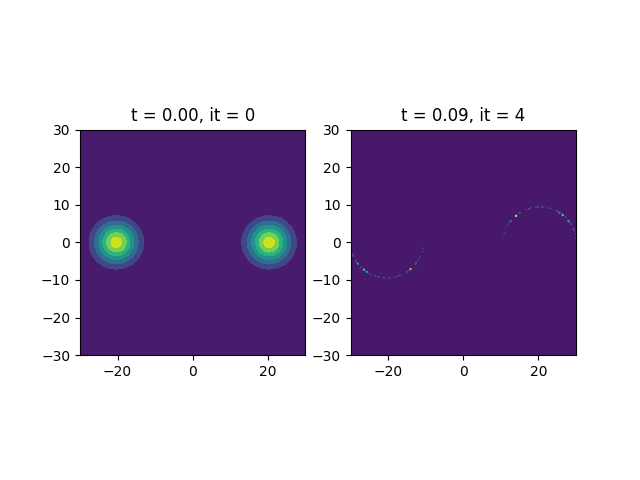
Lorenzo, I opened the hdf5 file you sent me and I indeed see the same problem (I attached a couple of snapshots). So it is not a problem of resolution. Did you check that hydro quantities and spacetime variables are initialized correctly (just in case there is a problem with the initial data file)?
Cheers, Bruno
Il giorno gio 18 gen 2024 alle ore 14:55 Lorenzo Cipriani < lorenzo.cipriani@graduate.univaq.it> ha scritto:
Dear Bruno,
I increased the resolution so that the finest level now has a resolution of 7/2^5 = 0.21875 using a smaller coarse grid, but the output remains unchanged.
Please let me know your thoughts on this!
Best, Lorenzo
*Da:* Bruno Giacomazzo bruno.giacomazzo@unimib.it *Inviato:* mercoledì 17 gennaio 2024 16:44 *A:* Lorenzo Cipriani lorenzo.cipriani@graduate.univaq.it *Cc:* users@einsteintoolkit.org users@einsteintoolkit.org *Oggetto:* Re: [Users] Star disappear from grid
Lorenzo, the perfectly cut away may be due to the fact that you may have had failures in con2prim on the finest levels (and maybe points got set to atmosphere), but the coarser levels were not computed yet. Your standard output reports indeed errors in c2p. You use 6 refinement levels and therefore all levels are at the same time every 2^(6-1)=32 iterations. At iteration 4 only the 3 most inner levels would be at the same.
I would increase the resolution since your finest grid is using a resolution of 12/2^5 = 0.375 so that you have a resolution of at least 0.24 on the finest level (level 5) and check if this solves the problem.
Cheers, Bruno
Il giorno mer 17 gen 2024 alle ore 15:41 Lorenzo Cipriani < lorenzo.cipriani@graduate.univaq.it> ha scritto:
Dear all, my name is Lorenzo Cipriani, PhD student at the University of L'Aquila.
My goal is to simulate a BNS merger using initial data computed from Lorene and evolved according to the parameter file I have attached. Cactus reads the initial data correctly, as you can see in the image "rhoxy_initial.png" but, immediately after, the stars practically disappear from the grid, perfectly cut away (see image "rhoxy_it4.png").
Does anybody have a hint on what might be happening? I have never encountered a behavior like this.
Thank you for your assistance, best regards, Lorenzo _______________________________________________ Users mailing list Users@einsteintoolkit.org http://lists.einsteintoolkit.org/mailman/listinfo/users
--
Prof. Bruno Giacomazzo Department of Physics University of Milano-Bicocca Piazza della Scienza 3 20126 Milano Italy
email: bruno.giacomazzo@unimib.it phone: (+39) 02 6448 2321 web: http://www.brunogiacomazzo.org
There are only 10 types of people in the world: Those who understand binary, and those who don't
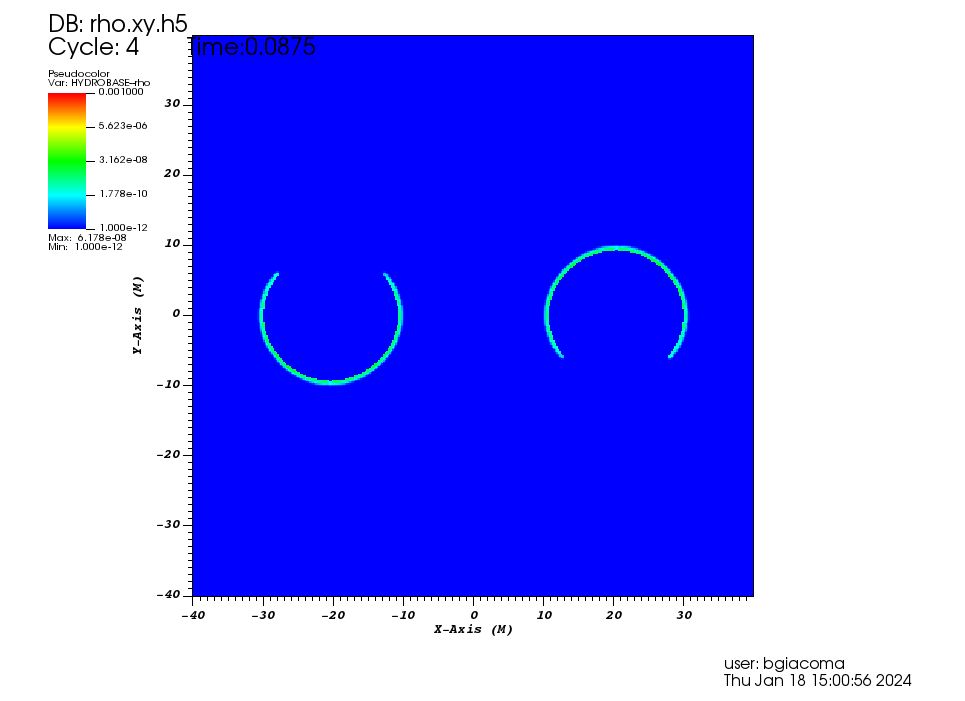
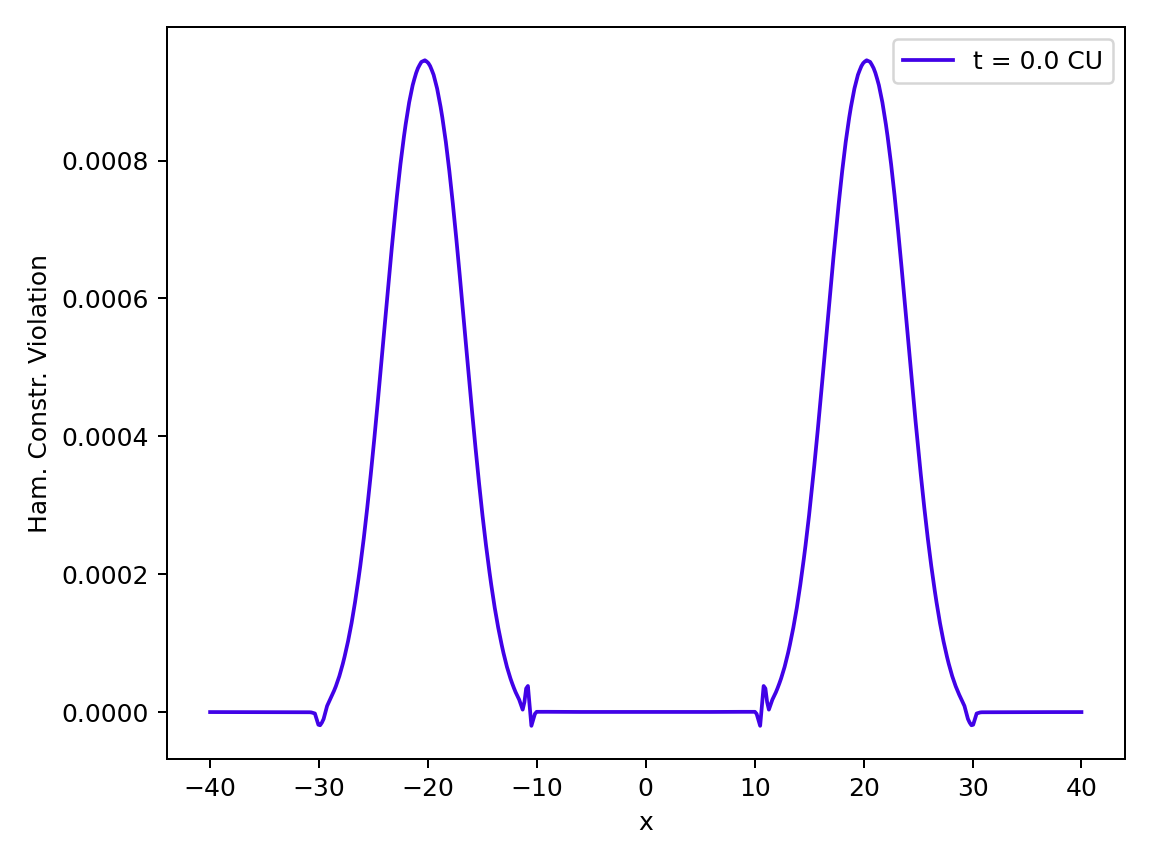
I noticed that the Hamiltonian constraint violation along the x-axis (y=0, z=0) (in the attached image, taken from the H.xy.h5 file), has a very peculiar shape, aligned with the stars profile. This is very wrong, am I right? So, the problem is either in the EoS, more likely, or Lorene.
Lorenzo ________________________________ Da: Bruno Giacomazzo bruno.giacomazzo@unimib.it Inviato: giovedì 18 gennaio 2024 15:13 A: Lorenzo Cipriani lorenzo.cipriani@graduate.univaq.it Cc: users@einsteintoolkit.org users@einsteintoolkit.org Oggetto: Re: [Users] Star disappear from grid
Lorenzo, I opened the hdf5 file you sent me and I indeed see the same problem (I attached a couple of snapshots). So it is not a problem of resolution. Did you check that hydro quantities and spacetime variables are initialized correctly (just in case there is a problem with the initial data file)?
Cheers, Bruno
Il giorno gio 18 gen 2024 alle ore 14:55 Lorenzo Cipriani <lorenzo.cipriani@graduate.univaq.itmailto:lorenzo.cipriani@graduate.univaq.it> ha scritto: Dear Bruno,
I increased the resolution so that the finest level now has a resolution of 7/2^5 = 0.21875 using a smaller coarse grid, but the output remains unchanged.
Please let me know your thoughts on this!
Best, Lorenzo
________________________________ Da: Bruno Giacomazzo <bruno.giacomazzo@unimib.itmailto:bruno.giacomazzo@unimib.it> Inviato: mercoledì 17 gennaio 2024 16:44 A: Lorenzo Cipriani <lorenzo.cipriani@graduate.univaq.itmailto:lorenzo.cipriani@graduate.univaq.it> Cc: users@einsteintoolkit.orgmailto:users@einsteintoolkit.org <users@einsteintoolkit.orgmailto:users@einsteintoolkit.org> Oggetto: Re: [Users] Star disappear from grid
Lorenzo, the perfectly cut away may be due to the fact that you may have had failures in con2prim on the finest levels (and maybe points got set to atmosphere), but the coarser levels were not computed yet. Your standard output reports indeed errors in c2p. You use 6 refinement levels and therefore all levels are at the same time every 2^(6-1)=32 iterations. At iteration 4 only the 3 most inner levels would be at the same.
I would increase the resolution since your finest grid is using a resolution of 12/2^5 = 0.375 so that you have a resolution of at least 0.24 on the finest level (level 5) and check if this solves the problem.
Cheers, Bruno
Il giorno mer 17 gen 2024 alle ore 15:41 Lorenzo Cipriani <lorenzo.cipriani@graduate.univaq.itmailto:lorenzo.cipriani@graduate.univaq.it> ha scritto: Dear all, my name is Lorenzo Cipriani, PhD student at the University of L'Aquila.
My goal is to simulate a BNS merger using initial data computed from Lorene and evolved according to the parameter file I have attached. Cactus reads the initial data correctly, as you can see in the image "rhoxy_initial.png" but, immediately after, the stars practically disappear from the grid, perfectly cut away (see image "rhoxy_it4.png").
Does anybody have a hint on what might be happening? I have never encountered a behavior like this.
Thank you for your assistance, best regards, Lorenzo _______________________________________________ Users mailing list Users@einsteintoolkit.orgmailto:Users@einsteintoolkit.org http://lists.einsteintoolkit.org/mailman/listinfo/users
--
Prof. Bruno Giacomazzo Department of Physics University of Milano-Bicocca Piazza della Scienza 3 20126 Milano Italy
email: bruno.giacomazzo@unimib.itmailto:bruno.giacomazzo@unimib.it phone: (+39) 02 6448 2321 web: http://www.brunogiacomazzo.orghttp://www.brunogiacomazzo.org/
--------------------------------------------------------------------- There are only 10 types of people in the world: Those who understand binary, and those who don't ----------------------------------------------------------------------
--
Prof. Bruno Giacomazzo Department of Physics University of Milano-Bicocca Piazza della Scienza 3 20126 Milano Italy
email: bruno.giacomazzo@unimib.itmailto:bruno.giacomazzo@unimib.it phone: (+39) 02 6448 2321 web: http://www.brunogiacomazzo.orghttp://www.brunogiacomazzo.org/
--------------------------------------------------------------------- There are only 10 types of people in the world: Those who understand binary, and those who don't ----------------------------------------------------------------------

Dear Lorenzo,
It is to be expected that the region with the highest density and gravity is the one with the highest constraint violation.
I think that the problem you are seeing is an output one.
(Disclaimer, this is my understanding; I might very well be wrong)
You have several refinement levels. Different refinement levels evolve at a different pace (determined by your time_refinement_factors, which by default is essentially proportionally to your local dx), and iteration #4 (that you are plotting) is not one where all the refinement levels are synced.
My guess is that the stars will appear if you plot iterations 128.
You might also be able use kuibit to inspect your HDF5 files and see what refinement levels are in the data.
That would be something like: ``` import kuibit print(SimDir("PATH_OF_DATA_FOLDER").gf.xy["rho"][4].available_refinement_levels) ```
Best, Gabriele
On Thu, Jan 18, 2024 at 3:30 PM Lorenzo Cipriani < lorenzo.cipriani@graduate.univaq.it> wrote:
I noticed that the Hamiltonian constraint violation along the x-axis (y=0, z=0) (in the attached image, taken from the H.xy.h5 file), has a very peculiar shape, aligned with the stars profile. This is very wrong, am I right? So, the problem is either in the EoS, more likely, or Lorene.
Lorenzo
*Da:* Bruno Giacomazzo bruno.giacomazzo@unimib.it *Inviato:* giovedì 18 gennaio 2024 15:13 *A:* Lorenzo Cipriani lorenzo.cipriani@graduate.univaq.it *Cc:* users@einsteintoolkit.org users@einsteintoolkit.org *Oggetto:* Re: [Users] Star disappear from grid
Lorenzo, I opened the hdf5 file you sent me and I indeed see the same problem (I attached a couple of snapshots). So it is not a problem of resolution. Did you check that hydro quantities and spacetime variables are initialized correctly (just in case there is a problem with the initial data file)?
Cheers, Bruno
Il giorno gio 18 gen 2024 alle ore 14:55 Lorenzo Cipriani < lorenzo.cipriani@graduate.univaq.it> ha scritto:
Dear Bruno,
I increased the resolution so that the finest level now has a resolution of 7/2^5 = 0.21875 using a smaller coarse grid, but the output remains unchanged.
Please let me know your thoughts on this!
Best, Lorenzo
*Da:* Bruno Giacomazzo bruno.giacomazzo@unimib.it *Inviato:* mercoledì 17 gennaio 2024 16:44 *A:* Lorenzo Cipriani lorenzo.cipriani@graduate.univaq.it *Cc:* users@einsteintoolkit.org users@einsteintoolkit.org *Oggetto:* Re: [Users] Star disappear from grid
Lorenzo, the perfectly cut away may be due to the fact that you may have had failures in con2prim on the finest levels (and maybe points got set to atmosphere), but the coarser levels were not computed yet. Your standard output reports indeed errors in c2p. You use 6 refinement levels and therefore all levels are at the same time every 2^(6-1)=32 iterations. At iteration 4 only the 3 most inner levels would be at the same.
I would increase the resolution since your finest grid is using a resolution of 12/2^5 = 0.375 so that you have a resolution of at least 0.24 on the finest level (level 5) and check if this solves the problem.
Cheers, Bruno
Il giorno mer 17 gen 2024 alle ore 15:41 Lorenzo Cipriani < lorenzo.cipriani@graduate.univaq.it> ha scritto:
Dear all, my name is Lorenzo Cipriani, PhD student at the University of L'Aquila.
My goal is to simulate a BNS merger using initial data computed from Lorene and evolved according to the parameter file I have attached. Cactus reads the initial data correctly, as you can see in the image "rhoxy_initial.png" but, immediately after, the stars practically disappear from the grid, perfectly cut away (see image "rhoxy_it4.png").
Does anybody have a hint on what might be happening? I have never encountered a behavior like this.
Thank you for your assistance, best regards, Lorenzo _______________________________________________ Users mailing list Users@einsteintoolkit.org http://lists.einsteintoolkit.org/mailman/listinfo/users
--
Prof. Bruno Giacomazzo Department of Physics University of Milano-Bicocca Piazza della Scienza 3 20126 Milano Italy
email: bruno.giacomazzo@unimib.it phone: (+39) 02 6448 2321 web: http://www.brunogiacomazzo.org
There are only 10 types of people in the world: Those who understand binary, and those who don't
--
Prof. Bruno Giacomazzo Department of Physics University of Milano-Bicocca Piazza della Scienza 3 20126 Milano Italy
email: bruno.giacomazzo@unimib.it phone: (+39) 02 6448 2321 web: http://www.brunogiacomazzo.org
There are only 10 types of people in the world: Those who understand binary, and those who don't
Users mailing list Users@einsteintoolkit.org http://lists.einsteintoolkit.org/mailman/listinfo/users
Hi Gabriele,
indeed, at iteration 4 there are only two refinement levels available (5th and 6th ), but between these first iterations all matter disappears from the grid. The simulation never reaches the point in which they are all synchronized.
Lorenzo
________________________________ Da: Gabriele Bozzola bozzola.gabriele@gmail.com Inviato: venerdì 19 gennaio 2024 00:53 A: Lorenzo Cipriani lorenzo.cipriani@graduate.univaq.it Cc: Bruno Giacomazzo bruno.giacomazzo@unimib.it; users@einsteintoolkit.org users@einsteintoolkit.org Oggetto: Re: [Users] R: Star disappear from grid
Dear Lorenzo,
It is to be expected that the region with the highest density and gravity is the one with the highest constraint violation.
I think that the problem you are seeing is an output one.
(Disclaimer, this is my understanding; I might very well be wrong)
You have several refinement levels. Different refinement levels evolve at a different pace (determined by your time_refinement_factors, which by default is essentially proportionally to your local dx), and iteration #4 (that you are plotting) is not one where all the refinement levels are synced.
My guess is that the stars will appear if you plot iterations 128.
You might also be able use kuibit to inspect your HDF5 files and see what refinement levels are in the data.
That would be something like: ``` import kuibit print(SimDir("PATH_OF_DATA_FOLDER").gf.xy["rho"][4].available_refinement_levels) ```
Best, Gabriele
On Thu, Jan 18, 2024 at 3:30 PM Lorenzo Cipriani <lorenzo.cipriani@graduate.univaq.itmailto:lorenzo.cipriani@graduate.univaq.it> wrote: I noticed that the Hamiltonian constraint violation along the x-axis (y=0, z=0) (in the attached image, taken from the H.xy.h5 file), has a very peculiar shape, aligned with the stars profile. This is very wrong, am I right? So, the problem is either in the EoS, more likely, or Lorene.
Lorenzo ________________________________ Da: Bruno Giacomazzo <bruno.giacomazzo@unimib.itmailto:bruno.giacomazzo@unimib.it> Inviato: giovedì 18 gennaio 2024 15:13 A: Lorenzo Cipriani <lorenzo.cipriani@graduate.univaq.itmailto:lorenzo.cipriani@graduate.univaq.it> Cc: users@einsteintoolkit.orgmailto:users@einsteintoolkit.org <users@einsteintoolkit.orgmailto:users@einsteintoolkit.org> Oggetto: Re: [Users] Star disappear from grid
Lorenzo, I opened the hdf5 file you sent me and I indeed see the same problem (I attached a couple of snapshots). So it is not a problem of resolution. Did you check that hydro quantities and spacetime variables are initialized correctly (just in case there is a problem with the initial data file)?
Cheers, Bruno
Il giorno gio 18 gen 2024 alle ore 14:55 Lorenzo Cipriani <lorenzo.cipriani@graduate.univaq.itmailto:lorenzo.cipriani@graduate.univaq.it> ha scritto: Dear Bruno,
I increased the resolution so that the finest level now has a resolution of 7/2^5 = 0.21875 using a smaller coarse grid, but the output remains unchanged.
Please let me know your thoughts on this!
Best, Lorenzo
________________________________ Da: Bruno Giacomazzo <bruno.giacomazzo@unimib.itmailto:bruno.giacomazzo@unimib.it> Inviato: mercoledì 17 gennaio 2024 16:44 A: Lorenzo Cipriani <lorenzo.cipriani@graduate.univaq.itmailto:lorenzo.cipriani@graduate.univaq.it> Cc: users@einsteintoolkit.orgmailto:users@einsteintoolkit.org <users@einsteintoolkit.orgmailto:users@einsteintoolkit.org> Oggetto: Re: [Users] Star disappear from grid
Lorenzo, the perfectly cut away may be due to the fact that you may have had failures in con2prim on the finest levels (and maybe points got set to atmosphere), but the coarser levels were not computed yet. Your standard output reports indeed errors in c2p. You use 6 refinement levels and therefore all levels are at the same time every 2^(6-1)=32 iterations. At iteration 4 only the 3 most inner levels would be at the same.
I would increase the resolution since your finest grid is using a resolution of 12/2^5 = 0.375 so that you have a resolution of at least 0.24 on the finest level (level 5) and check if this solves the problem.
Cheers, Bruno
Il giorno mer 17 gen 2024 alle ore 15:41 Lorenzo Cipriani <lorenzo.cipriani@graduate.univaq.itmailto:lorenzo.cipriani@graduate.univaq.it> ha scritto: Dear all, my name is Lorenzo Cipriani, PhD student at the University of L'Aquila.
My goal is to simulate a BNS merger using initial data computed from Lorene and evolved according to the parameter file I have attached. Cactus reads the initial data correctly, as you can see in the image "rhoxy_initial.png" but, immediately after, the stars practically disappear from the grid, perfectly cut away (see image "rhoxy_it4.png").
Does anybody have a hint on what might be happening? I have never encountered a behavior like this.
Thank you for your assistance, best regards, Lorenzo _______________________________________________ Users mailing list Users@einsteintoolkit.orgmailto:Users@einsteintoolkit.org http://lists.einsteintoolkit.org/mailman/listinfo/users
--
Prof. Bruno Giacomazzo Department of Physics University of Milano-Bicocca Piazza della Scienza 3 20126 Milano Italy
email: bruno.giacomazzo@unimib.itmailto:bruno.giacomazzo@unimib.it phone: (+39) 02 6448 2321 web: http://www.brunogiacomazzo.orghttp://www.brunogiacomazzo.org/
--------------------------------------------------------------------- There are only 10 types of people in the world: Those who understand binary, and those who don't ----------------------------------------------------------------------
--
Prof. Bruno Giacomazzo Department of Physics University of Milano-Bicocca Piazza della Scienza 3 20126 Milano Italy
email: bruno.giacomazzo@unimib.itmailto:bruno.giacomazzo@unimib.it phone: (+39) 02 6448 2321 web: http://www.brunogiacomazzo.orghttp://www.brunogiacomazzo.org/
--------------------------------------------------------------------- There are only 10 types of people in the world: Those who understand binary, and those who don't ----------------------------------------------------------------------
_______________________________________________ Users mailing list Users@einsteintoolkit.orgmailto:Users@einsteintoolkit.org http://lists.einsteintoolkit.org/mailman/listinfo/users
users@lists.einsteintoolkit.org
-
 Bruno Giacomazzo
 -
 Gabriele Bozzola
 -
 Lorenzo Cipriani