
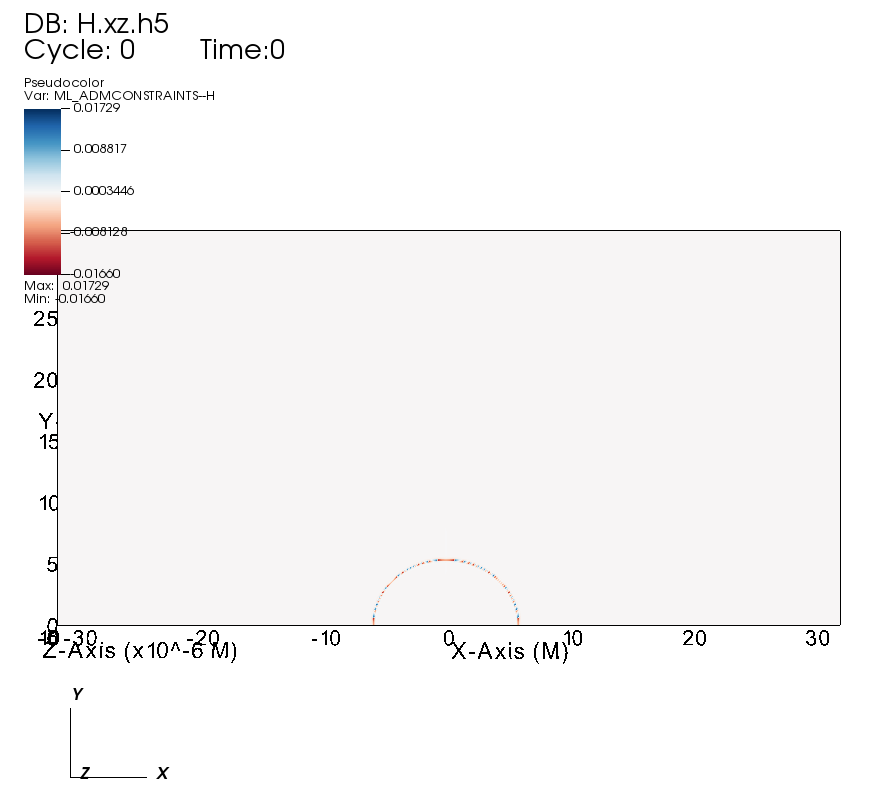
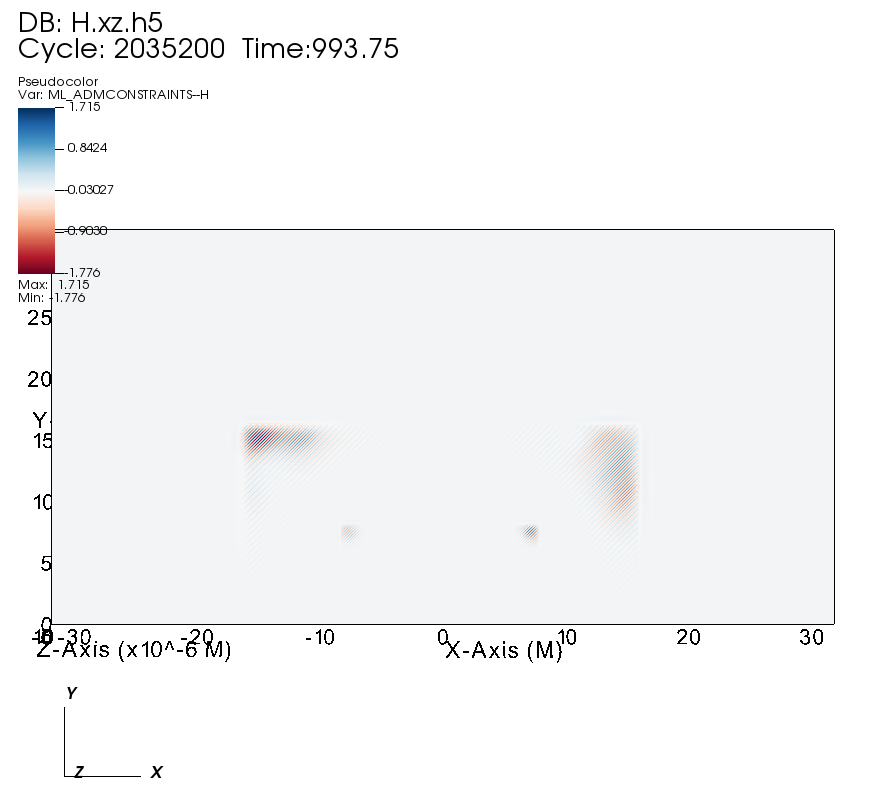
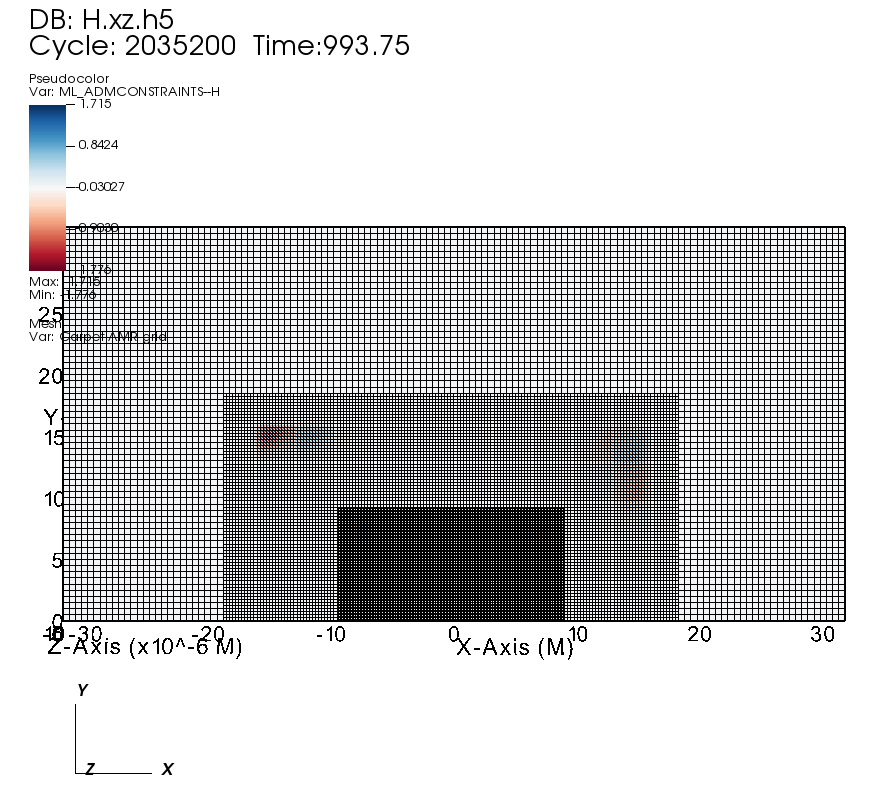
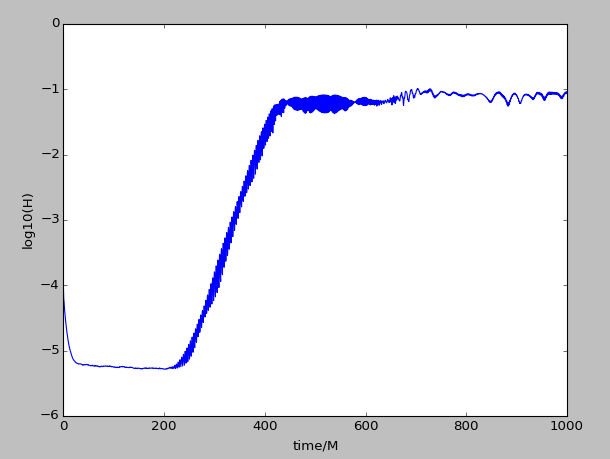
While using CCZ4 to simulate a single star, the Hamiltonian constraint violation initially came from the star surface as expected, but after some time, the violation was dominated by areas near corners of refinement levels (by Carpet) as shown in following figures, which were strange. Any suggestions?
Thanks and regards, KZ
[cid:dde3bc76-5092-4cf5-91c4-2e86b59e3dbd] [cid:f02f345c-bc52-4701-9d0c-66013d123c95] [cid:ea736a88-1566-4321-93c6-093fbd7bad35] [cid:9c6d9aca-98f3-4488-ae60-b927bd525ff4]

Hi Kenneth,
It is expected that the mesh refinement boundaries will reflect Hamiltonian constraint violations. From what you have provided us, it is not clear whether the level of constraint violations that you see is a cause of concern. You specifically mention CCZ4, but have you tried with BSSN? Does the constraint violations look better, the same, or worse with BSSN?
It is also possible that an issue like this might be caused by some other problem potentially related to parameter settings, so in order to investigate this can you provide your thornlist and parameter file?
Cheers,
Peter
On Sun, 4 Jul 2021, CHEN, Kenneth wrote:
While using CCZ4 to simulate a single star, the Hamiltonian constraint violation initially came from the star surface as expected, but after some time, the violation was dominated by areas near corners of refinement levels (by Carpet) as shown in following figures, which were strange. Any suggestions?
Thanks and regards, KZ
[IMAGE] [IMAGE] [IMAGE] [IMAGE]
Hi, Peter,
Thanks for your suggestions, which are quite helpful.
I was using the independent "Dissipation" thorn Dissipation::epsdis = 0.1 Dissipation::order = 5 Dissipation::vars = " ML_CCZ4::ML_log_confac ML_CCZ4::ML_metric ML_CCZ4::ML_trace_curv ML_CCZ4::ML_curv ML_CCZ4::ML_Gamma ML_CCZ4::ML_lapse ML_CCZ4::ML_shift ML_CCZ4::ML_dtlapse ML_CCZ4::ML_dtshift " for RK4, which turned out to be not enough dissipation for damping out the high frequency oscillation of the constrain violation.
Then I turned on the dissipation of ML_CCZ4::epsdiss = 0.1, It worked, no more large violation near refinement boundaries.
However, not very sure about how these two "epsdis" work differently.
BR KZ
________________________________ From: Peter Diener diener@cct.lsu.edu Sent: Thursday, July 8, 2021 10:47 PM To: CHEN, Kenneth kchen@link.cuhk.edu.hk Cc: users@einsteintoolkit.org users@einsteintoolkit.org Subject: Re: [Users] Unexpected Hamiltonian constraint violation from refinement when using CCZ4
Hi Kenneth,
It is expected that the mesh refinement boundaries will reflect Hamiltonian constraint violations. From what you have provided us, it is not clear whether the level of constraint violations that you see is a cause of concern. You specifically mention CCZ4, but have you tried with BSSN? Does the constraint violations look better, the same, or worse with BSSN?
It is also possible that an issue like this might be caused by some other problem potentially related to parameter settings, so in order to investigate this can you provide your thornlist and parameter file?
Cheers,
Peter
On Sun, 4 Jul 2021, CHEN, Kenneth wrote:
While using CCZ4 to simulate a single star, the Hamiltonian constraint violation initially came from the star surface as expected, but after some time, the violation was dominated by areas near corners of refinement levels (by Carpet) as shown in following figures, which were strange. Any suggestions?
Thanks and regards, KZ
[IMAGE] [IMAGE] [IMAGE] [IMAGE]
Hi Kenneth,
With the parameter settings using the "Dissipation" thorn, you were not applying dissipation to all evolved variables. When using CCZ4 the variable Theta is also evolved. When you switched to the "built in" dissipation it is automatically applied to all evolved variables.
So I suspect that using the "Dissipation" thorn will work if you add
ML_CCZ4::ML_Theta
to the list of disspation vars, that should work as well.
Cheers,
Peter
On Thu, 22 Jul 2021, CHEN, Kenneth wrote:
Hi, Peter,
Thanks for your suggestions, which are quite helpful.
I was using the independent "Dissipation" thorn Dissipation::epsdis = 0.1 Dissipation::order = 5 Dissipation::vars = " ML_CCZ4::ML_log_confac ML_CCZ4::ML_metric ML_CCZ4::ML_trace_curv ML_CCZ4::ML_curv ML_CCZ4::ML_Gamma ML_CCZ4::ML_lapse ML_CCZ4::ML_shift ML_CCZ4::ML_dtlapse ML_CCZ4::ML_dtshift " for RK4, which turned out to be not enough dissipation for damping out the high frequency oscillation of the constrain violation.
Then I turned on the dissipation of ML_CCZ4::epsdiss = 0.1, It worked, no more large violation near refinement boundaries.
However, not very sure about how these two "epsdis" work differently.
BR KZ
From: Peter Diener diener@cct.lsu.edu Sent: Thursday, July 8, 2021 10:47 PM To: CHEN, Kenneth kchen@link.cuhk.edu.hk Cc: users@einsteintoolkit.org users@einsteintoolkit.org Subject: Re: [Users] Unexpected Hamiltonian constraint violation from refinement when using CCZ4 Hi Kenneth,
It is expected that the mesh refinement boundaries will reflect Hamiltonian constraint violations. From what you have provided us, it is not clear whether the level of constraint violations that you see is a cause of concern. You specifically mention CCZ4, but have you tried with BSSN? Does the constraint violations look better, the same, or worse with BSSN?
It is also possible that an issue like this might be caused by some other problem potentially related to parameter settings, so in order to investigate this can you provide your thornlist and parameter file?
Cheers,
Peter
On Sun, 4 Jul 2021, CHEN, Kenneth wrote:
While using CCZ4 to simulate a single star, the Hamiltonian constraint violation initially came from the star surface as expected, but after some time, the violation was dominated by areas near corners of refinement
levels
(by Carpet) as shown in following figures, which were strange. Any suggestions?
Thanks and regards, KZ
[IMAGE] [IMAGE] [IMAGE] [IMAGE]
users@lists.einsteintoolkit.org
-
 CHEN, Kenneth
 -
 Peter Diener