
Hi. This may be related to something Yosef brought up back in July ["Differences in results ..." from 26 July], but I'm seeing sizable differences in WF amplitudes from Multipole when running the parameter files for the ETK paper (Loeffler et al.).
Specifically, if I take the parameter file
<Cactus>/par/arXiv:1111.3344/bbh/BBHMedHRes.par
... and run it with a Curie (ET_2011_05) executable, my r=30M (2,2) mode has a peak magnitude of just above 0.0027. Rerunning the same parameter file with *no* changes, using the current release, Lovelace (ET_2012_05), the same peak amplitude is just above 0.00257 -- a drop of almost 5%.
Can anyone tell me what might be going wrong? Is there some kind of change in default dissipation that could explain such a large discrepancy? Does anyone have a drop-in replacement for these parameter files that will actually match the *results* from the Curie executable?
Thanks,
Bernard
---------------------------------------------------------------------------

On 7 Nov 2012, at 20:29, "Kelly, Bernard J. (GSFC-660.0)[UNIVERSITY OF MARYLAND BALTIMORE COUNTY]" bernard.j.kelly@nasa.gov wrote:
Hi. This may be related to something Yosef brought up back in July ["Differences in results ..." from 26 July], but I'm seeing sizable differences in WF amplitudes from Multipole when running the parameter files for the ETK paper (Loeffler et al.).
Specifically, if I take the parameter file
<Cactus>/par/arXiv:1111.3344/bbh/BBHMedHRes.par
... and run it with a Curie (ET_2011_05) executable, my r=30M (2,2) mode has a peak magnitude of just above 0.0027. Rerunning the same parameter file with *no* changes, using the current release, Lovelace (ET_2012_05), the same peak amplitude is just above 0.00257 -- a drop of almost 5%.
Can anyone tell me what might be going wrong? Is there some kind of change in default dissipation that could explain such a large discrepancy?
I don't think so. McLachlan with its default parameters has always disabled dissipation. We changed the default of apply_dissipation very recently (i.e. after Lovelace) from "true" to "false" (and announced this on the list), but the dissipation strength has always defaulted to zero.
Dissipation in that parameter file is provided by the Dissipation thorn, and it uses its default value of epsdiss = 0.2.
Could this be related to the change in grid structure going from the "git" to the "mercurial" version of Carpet? Are the grid structures the same? You can output the grid structure to an ASCII file using
Carpet::grid_coordinates_filename = "carpet-grid.asc"
Can you try to narrow down where the differences lie? For example, you could look at the grid functions themselves, including one of the evolved variables, one of the ADMBase variables, and also Psi4, to see which are actually different.
Hi Ian. Thanks for the diagnostic suggestions.
On 11/7/12 3:59 PM, "Ian Hinder" ian.hinder@aei.mpg.de wrote:
On 7 Nov 2012, at 20:29, "Kelly, Bernard J. (GSFC-660.0)[UNIVERSITY OF MARYLAND BALTIMORE COUNTY]" bernard.j.kelly@nasa.gov wrote:
Hi. This may be related to something Yosef brought up back in July ["Differences in results ..." from 26 July], but I'm seeing sizable differences in WF amplitudes from Multipole when running the parameter files for the ETK paper (Loeffler et al.).
Specifically, if I take the parameter file
<Cactus>/par/arXiv:1111.3344/bbh/BBHMedHRes.par
... and run it with a Curie (ET_2011_05) executable, my r=30M (2,2) mode has a peak magnitude of just above 0.0027. Rerunning the same parameter file with *no* changes, using the current release, Lovelace (ET_2012_05), the same peak amplitude is just above 0.00257 -- a drop of almost 5%.
Can anyone tell me what might be going wrong? Is there some kind of change in default dissipation that could explain such a large discrepancy?
I don't think so. McLachlan with its default parameters has always disabled dissipation. We changed the default of apply_dissipation very recently (i.e. after Lovelace) from "true" to "false" (and announced this on the list), but the dissipation strength has always defaulted to zero.
Dissipation in that parameter file is provided by the Dissipation thorn, and it uses its default value of epsdiss = 0.2.
Could this be related to the change in grid structure going from the "git" to the "mercurial" version of Carpet? Are the grid structures the same? You can output the grid structure to an ASCII file using
Carpet::grid_coordinates_filename = "carpet-grid.asc"
I'm attaching some excerpts from the carpet-grid-coordinates files of both runs ("MedRes" version). They're snapshots from iterations 0, 609, and 2145. For the latter two iterations, the grid does seem to be different in the y-direction (the only direction without a symmetry boundary), but only for certain refinement levels. The it=0 output is very different for the two cases; I'm not sure why.
Also, the Curie executable generated this diagnostic information *far* more frequently (every 32 iterations) than Lovelace (every 384). Obviously, the times I've chosen were common to both.
Can you try to narrow down where the differences lie? For example, you could look at the grid functions themselves, including one of the evolved variables, one of the ADMBase variables, and also Psi4, to see which are actually different.
I'll look at the 1D grid functions now, but I wanted to get you this info anyway.
Bernard
Hi Ian and others. Coming back to this unresolved issue ...
I've looked at 1D metric files from a fairly advanced point in the evolution, and can see no differences in the metric components from the two evolutions. It's difficult to do precise differencing, since the grids are not commensurate, as pointed out before.
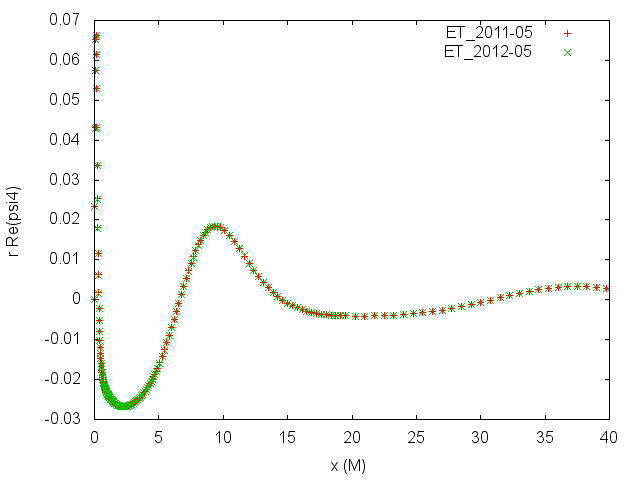
More directly, I've looked at the WeylScal4 waveforms along the coordinate axes, and they show no sign of the amplitude discrepancy. Attached is the output from psi4 along the x-axis at around 120M in the evolution (Med resolution).
So it looks like the change is in the Multipole extraction. Diffing the two Multipole thorns (and ignoring test-suite file changes), I only see minor changes in the schedule.ccl:
8c8 < schedule Multipole_Calc at CCTK_ANALYSIS after (calc_np,PsiKadelia) ---
schedule Multipole_Calc at CCTK_ANALYSIS after (calc_np,PsiKadelia,Accelerator_CopyBack)
Again: has anyone run the Curie-era paper's "bbh" parameter files with a later release of ET and obtained *exactly* the same WF amplitudes? Or a difference within 1%?
Bernard
On 11/9/12 1:24 PM, "Kelly, Bernard J. (GSFC-660.0)[UNIVERSITY OF MARYLAND BALTIMORE COUNTY]" bernard.j.kelly@nasa.gov wrote:
Hi Ian. Thanks for the diagnostic suggestions.
On 11/7/12 3:59 PM, "Ian Hinder" ian.hinder@aei.mpg.de wrote:
On 7 Nov 2012, at 20:29, "Kelly,
Bernard J. (GSFC-660.0)[UNIVERSITY OF
MARYLAND BALTIMORE COUNTY]"
bernard.j.kelly@nasa.gov wrote:
Hi. This may be related to something
Yosef brought up back in July
["Differences in results ..." from 26
July], but I'm seeing sizable
differences in WF amplitudes from Multipole
when running the parameter
files for the ETK paper (Loeffler et al.).
Specifically, if I take the parameter file
<Cactus>/par/arXiv:1111.3344/bbh/BBHMedHRes.par
... and run it with a
Curie (ET_2011_05) executable, my r=30M (2,2) mode
has a peak magnitude
of just above 0.0027. Rerunning the same parameter
file with *no*
changes, using the current release, Lovelace
(ET_2012_05), the same
peak amplitude is just above 0.00257 -- a drop of almost 5%.
Can
anyone tell me what might be going wrong? Is there some kind of
change
in default dissipation that could explain such a large discrepancy?
I
don't think so. McLachlan with its default parameters has always
disabled
dissipation. We changed the default of apply_dissipation very
recently
(i.e. after Lovelace) from "true" to "false" (and announced this
on the
list), but the dissipation strength has always defaulted to zero.
Dissipation in that parameter file is provided by the Dissipation
thorn,
and it uses its default value of epsdiss = 0.2.
Could this be
related to the change in grid structure going from the
"git" to the
"mercurial" version of Carpet? Are the grid structures the
same? You can
output the grid structure to an ASCII file using
Carpet::grid_coordinates_filename = "carpet-grid.asc"
I'm attaching some excerpts from the carpet-grid-coordinates files of both runs ("MedRes" version). They're snapshots from iterations 0, 609, and 2145. For the latter two iterations, the grid does seem to be different in the y-direction (the only direction without a symmetry boundary), but only for certain refinement levels. The it=0 output is very different for the two cases; I'm not sure why.
Also, the Curie executable generated this diagnostic information *far* more frequently (every 32 iterations) than Lovelace (every 384). Obviously, the times I've chosen were common to both.
Can you try to narrow down where the differences lie? For
example, you
could look at the grid functions themselves, including one of
the evolved
variables, one of the ADMBase variables, and also Psi4, to see
which are
actually different.
I'll look at the 1D grid functions now, but I wanted to get you this info anyway.
Bernard

Bernard
Maybe there is a change in the interpolation scheme used for the multipole extraction? There may have been some changes regarding how buffer points are treated.
-erik
On Fri, Nov 30, 2012 at 11:07 AM, Kelly, Bernard J. (GSFC-660.0)[UNIVERSITY OF MARYLAND BALTIMORE COUNTY] bernard.j.kelly@nasa.gov wrote:
Hi Ian and others. Coming back to this unresolved issue ...
I've looked at 1D metric files from a fairly advanced point in the evolution, and can see no differences in the metric components from the two evolutions. It's difficult to do precise differencing, since the grids are not commensurate, as pointed out before.
More directly, I've looked at the WeylScal4 waveforms along the coordinate axes, and they show no sign of the amplitude discrepancy. Attached is the output from psi4 along the x-axis at around 120M in the evolution (Med resolution).
So it looks like the change is in the Multipole extraction. Diffing the two Multipole thorns (and ignoring test-suite file changes), I only see minor changes in the schedule.ccl:
8c8
< schedule Multipole_Calc at CCTK_ANALYSIS after (calc_np,PsiKadelia)
schedule Multipole_Calc at CCTK_ANALYSIS after (calc_np,PsiKadelia,Accelerator_CopyBack)
Again: has anyone run the Curie-era paper's "bbh" parameter files with a later release of ET and obtained *exactly* the same WF amplitudes? Or a difference within 1%?
Bernard
On 11/9/12 1:24 PM, "Kelly, Bernard J. (GSFC-660.0)[UNIVERSITY OF MARYLAND BALTIMORE COUNTY]" bernard.j.kelly@nasa.gov wrote:
Hi Ian. Thanks for the diagnostic suggestions.
On 11/7/12 3:59 PM, "Ian Hinder" ian.hinder@aei.mpg.de wrote:
On 7 Nov 2012, at 20:29, "Kelly,
Bernard J. (GSFC-660.0)[UNIVERSITY OF
MARYLAND BALTIMORE COUNTY]"
bernard.j.kelly@nasa.gov wrote:
Hi. This may be related to something
Yosef brought up back in July
["Differences in results ..." from 26
July], but I'm seeing sizable
differences in WF amplitudes from Multipole
when running the parameter
files for the ETK paper (Loeffler et al.).
Specifically, if I take the parameter file
<Cactus>/par/arXiv:1111.3344/bbh/BBHMedHRes.par
... and run it with a
Curie (ET_2011_05) executable, my r=30M (2,2) mode
has a peak magnitude
of just above 0.0027. Rerunning the same parameter
file with *no*
changes, using the current release, Lovelace
(ET_2012_05), the same
peak amplitude is just above 0.00257 -- a drop of almost 5%.
Can
anyone tell me what might be going wrong? Is there some kind of
change
in default dissipation that could explain such a large discrepancy?
I
don't think so. McLachlan with its default parameters has always
disabled
dissipation. We changed the default of apply_dissipation very
recently
(i.e. after Lovelace) from "true" to "false" (and announced this
on the
list), but the dissipation strength has always defaulted to zero.
Dissipation in that parameter file is provided by the Dissipation
thorn,
and it uses its default value of epsdiss = 0.2.
Could this be
related to the change in grid structure going from the
"git" to the
"mercurial" version of Carpet? Are the grid structures the
same? You can
output the grid structure to an ASCII file using
Carpet::grid_coordinates_filename = "carpet-grid.asc"I'm attaching some excerpts from the carpet-grid-coordinates files of both runs ("MedRes" version). They're snapshots from iterations 0, 609, and 2145. For the latter two iterations, the grid does seem to be different in the y-direction (the only direction without a symmetry boundary), but only for certain refinement levels. The it=0 output is very different for the two cases; I'm not sure why.
Also, the Curie executable generated this diagnostic information *far* more frequently (every 32 iterations) than Lovelace (every 384). Obviously, the times I've chosen were common to both.
Can you try to narrow down where the differences lie? For
example, you
could look at the grid functions themselves, including one of
the evolved
variables, one of the ADMBase variables, and also Psi4, to see
which are
actually different.
I'll look at the 1D grid functions now, but I wanted to get you this info anyway.
Bernard
Users mailing list Users@einsteintoolkit.org http://lists.einsteintoolkit.org/mailman/listinfo/users
Hi Erik.
Five minutes after hitting "Send", I thought to look at the interpolation scheme. It looks like I might have been using a local AEILocalInterp variation for the more recent run. Testing now ...
Bernard
From: Erik Schnetter <schnetter@cct.lsu.edumailto:schnetter@cct.lsu.edu> Date: Friday, November 30, 2012 11:34 AM To: Bernard Kelly <bernard.j.kelly@nasa.govmailto:bernard.j.kelly@nasa.gov> Cc: Ian Hinder <ian.hinder@aei.mpg.demailto:ian.hinder@aei.mpg.de>, "users@einsteintoolkit.orgmailto:users@einsteintoolkit.org" <users@einsteintoolkit.orgmailto:users@einsteintoolkit.org> Subject: Re: [Users] **large** amplitude changes in WFs from Curie "bbh" parfiles when run in ET_2012_05
Bernard
Maybe there is a change in the interpolation scheme used for the multipole extraction? There may have been some changes regarding how buffer points are treated.
-erik
On Fri, Nov 30, 2012 at 11:07 AM, Kelly, Bernard J. (GSFC-660.0)[UNIVERSITY OF MARYLAND BALTIMORE COUNTY] <bernard.j.kelly@nasa.govmailto:bernard.j.kelly@nasa.gov> wrote: Hi Ian and others. Coming back to this unresolved issue ...
I've looked at 1D metric files from a fairly advanced point in the evolution, and can see no differences in the metric components from the two evolutions. It's difficult to do precise differencing, since the grids are not commensurate, as pointed out before.
More directly, I've looked at the WeylScal4 waveforms along the coordinate axes, and they show no sign of the amplitude discrepancy. Attached is the output from psi4 along the x-axis at around 120M in the evolution (Med resolution).
So it looks like the change is in the Multipole extraction. Diffing the two Multipole thorns (and ignoring test-suite file changes), I only see minor changes in the schedule.ccl:
8c8 < schedule Multipole_Calc at CCTK_ANALYSIS after (calc_np,PsiKadelia) ---
schedule Multipole_Calc at CCTK_ANALYSIS after (calc_np,PsiKadelia,Accelerator_CopyBack)
Again: has anyone run the Curie-era paper's "bbh" parameter files with a later release of ET and obtained *exactly* the same WF amplitudes? Or a difference within 1%?
Bernard
On 11/9/12 1:24 PM, "Kelly, Bernard J. (GSFC-660.0)[UNIVERSITY OF MARYLAND BALTIMORE COUNTY]" <bernard.j.kelly@nasa.govmailto:bernard.j.kelly@nasa.gov> wrote:
Hi Ian. Thanks for the diagnostic suggestions.
On 11/7/12 3:59 PM, "Ian Hinder" <ian.hinder@aei.mpg.demailto:ian.hinder@aei.mpg.de> wrote:
On 7 Nov 2012, at 20:29, "Kelly,
Bernard J. (GSFC-660.0)[UNIVERSITY OF
MARYLAND BALTIMORE COUNTY]"
<bernard.j.kelly@nasa.govmailto:bernard.j.kelly@nasa.gov> wrote:
Hi. This may be related to something
Yosef brought up back in July
["Differences in results ..." from 26
July], but I'm seeing sizable
differences in WF amplitudes from Multipole
when running the parameter
files for the ETK paper (Loeffler et al.).
Specifically, if I take the parameter file
<Cactus>/par/arXiv:1111.3344/bbh/BBHMedHRes.par
... and run it with a
Curie (ET_2011_05) executable, my r=30M (2,2) mode
has a peak magnitude
of just above 0.0027. Rerunning the same parameter
file with *no*
changes, using the current release, Lovelace
(ET_2012_05), the same
peak amplitude is just above 0.00257 -- a drop of almost 5%.
Can
anyone tell me what might be going wrong? Is there some kind of
change
in default dissipation that could explain such a large discrepancy?
I
don't think so. McLachlan with its default parameters has always
disabled
dissipation. We changed the default of apply_dissipation very
recently
(i.e. after Lovelace) from "true" to "false" (and announced this
on the
list), but the dissipation strength has always defaulted to zero.
Dissipation in that parameter file is provided by the Dissipation
thorn,
and it uses its default value of epsdiss = 0.2.
Could this be
related to the change in grid structure going from the
"git" to the
"mercurial" version of Carpet? Are the grid structures the
same? You can
output the grid structure to an ASCII file using
Carpet::grid_coordinates_filename = "carpet-grid.asc"I'm attaching some excerpts from the carpet-grid-coordinates files of both runs ("MedRes" version). They're snapshots from iterations 0, 609, and 2145. For the latter two iterations, the grid does seem to be different in the y-direction (the only direction without a symmetry boundary), but only for certain refinement levels. The it=0 output is very different for the two cases; I'm not sure why.
Also, the Curie executable generated this diagnostic information *far* more frequently (every 32 iterations) than Lovelace (every 384). Obviously, the times I've chosen were common to both.
Can you try to narrow down where the differences lie? For
example, you
could look at the grid functions themselves, including one of
the evolved
variables, one of the ADMBase variables, and also Psi4, to see
which are
actually different.
I'll look at the 1D grid functions now, but I wanted to get you this info anyway.
Bernard
_______________________________________________ Users mailing list Users@einsteintoolkit.orgmailto:Users@einsteintoolkit.org http://lists.einsteintoolkit.org/mailman/listinfo/users
-- Erik Schnetter <schnetter@cct.lsu.edumailto:schnetter@cct.lsu.edu> http://www.perimeterinstitute.ca/personal/eschnetter/
users@lists.einsteintoolkit.org
-
 Erik Schnetter
 -
 Ian Hinder
 -
 Kelly, Bernard J. (GSFC-660.0)[UNIVERSITY OF MARYLAND BALTIMORE COUNTY]