
Hi
I'm reporting on recon_method dependency issue at least found in Turing and Lorentz. I've been studying BNS evolution by taking some of the Parma group models as references (DOI: 10.1103/PhysRevD.93.064047). But there were significant differences in merger time, t_merger. At the moment, I will put aside direct comparison between the GRHydro of Parma and recents ones.
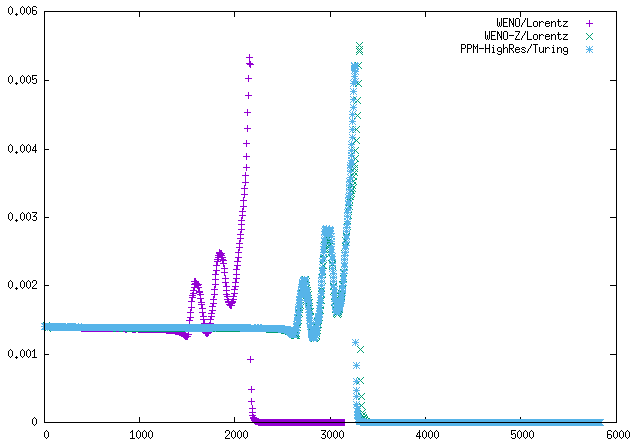
What I've found is that WENO of Turing/Lorentz produces much shorter inspiraling time (See the attached figure). But WENO-Z/PPM/MP5, they all produce similar inspiraling time. Of course, depending on resolutions, they produce different merging behaviour but as shown in the figure, higher-res PPM matches with lower-res WENO-Z nicely, which is consistent with our expectations. I've got the identical results for both Turing and Lorentz versions.
I've missed recent GRHydro developments for a long time and I have no guesses for the discrepancy. I hope GRHydro developers examine this issue for the consistency of the recon_method. Thanks for your help in advance.
Hee Il

Hello Hee Il,
from your email it seems that you are seeing differences between different ET releases but with the same par file.
Yet your plot seems to not show any pair of curves that only differ by the release code used.
If you are comparing to the runs by the Parma group (or any simulation) then you must ensure that you are comparing "apples with apples" ie you would have to run their parfiles with the current ET release (to check for a change) and also with their code (to check if the issue is compiler / cluster changes).
They provide their code and parfiles in:
https://einstein.pr.infn.it/svn/numrel/pub/
See "Background material" on
https://einstein.pr.infn.it/gravity/Research/BNS2016.html
which is listed on the "Additional Resources" page of:
https://docs.einsteintoolkit.org/et-docs/Additional_resources
Yours, Roland
Hi
I'm reporting on recon_method dependency issue at least found in Turing and Lorentz. I've been studying BNS evolution by taking some of the Parma group models as references (DOI: 10.1103/PhysRevD.93.064047). But there were significant differences in merger time, t_merger. At the moment, I will put aside direct comparison between the GRHydro of Parma and recents ones.
What I've found is that WENO of Turing/Lorentz produces much shorter inspiraling time (See the attached figure). But WENO-Z/PPM/MP5, they all produce similar inspiraling time. Of course, depending on resolutions, they produce different merging behaviour but as shown in the figure, higher-res PPM matches with lower-res WENO-Z nicely, which is consistent with our expectations. I've got the identical results for both Turing and Lorentz versions.
I've missed recent GRHydro developments for a long time and I have no guesses for the discrepancy. I hope GRHydro developers examine this issue for the consistency of the recon_method. Thanks for your help in advance.
Hee Il
Thanks Roland and Maria
2021년 6월 10일 (목) 오후 11:50, Roland Haas rhaas@illinois.edu님이 작성:
Hello Hee Il,
from your email it seems that you are seeing differences between different ET releases but with the same par file.
I'm not seeing different results between Turing and Lorentz. Since they are identical, I've shown only representative plots (rhomax vs time btw). The issue is that he WENO of the ET versions do not produce the same inspiraling time with that of WENO-Z, MP5, and PPM, whereas the other three recon methods show decent coincidence for the inspiralling time.
Yet your plot seems to not show any pair of curves that only differ by the release code used.
Explained above.
If you are comparing to the runs by the Parma group (or any simulation) then you must ensure that you are comparing "apples with apples" ie you would have to run their parfiles with the current ET release (to check for a change) and also with their code (to check if the issue is compiler / cluster changes).
I'm not going to compare my current results to the Parma group runs. As you discussed in the meeting, since they used the recon codes and Con2Prim for the MHD, it might give different results. But if the differences are big even with zero B, I think it needs to be examined further in the future.
They provide their code and parfiles in:
https://einstein.pr.infn.it/svn/numrel/pub/
See "Background material" on
https://einstein.pr.infn.it/gravity/Research/BNS2016.html
which is listed on the "Additional Resources" page of:
https://docs.einsteintoolkit.org/et-docs/Additional_resources
Yours, Roland
I've been aware of it and used its grid setup. At first, I didn't follow their parfile but used my own grid amr with NSTracker. But for the comparison, I followed the parfiles there. I haven't tried to use the entire code of the Parma group. But at least I found their Lorene is different from official Lorene and ET Lorenes. I've made an ID by using their Lorene but the ID was not readable by recent ET/GRHydros.
My feeling is that GRHydro_WenoRecontruct codes need to be examined.
Thanks,
Hee Il
Hi
I'm reporting on recon_method dependency issue at least found in Turing
and
Lorentz. I've been studying BNS evolution by taking some of the Parma
group
models as references (DOI: 10.1103/PhysRevD.93.064047). But there were significant differences in merger time, t_merger. At the moment, I will
put
aside direct comparison between the GRHydro of Parma and recents ones.
What I've found is that WENO of Turing/Lorentz produces much shorter inspiraling time (See the attached figure). But WENO-Z/PPM/MP5, they all produce similar inspiraling time. Of course, depending on resolutions,
they
produce different merging behaviour but as shown in the figure,
higher-res
PPM matches with lower-res WENO-Z nicely, which is consistent with our expectations. I've got the identical results for both Turing and Lorentz versions.
I've missed recent GRHydro developments for a long time and I have no guesses for the discrepancy. I hope GRHydro developers examine this issue for the consistency of the recon_method. Thanks for your help in advance.
Hee Il
-- My email is as private as my paper mail. I therefore support encrypting and signing email messages. Get my PGP key from http://pgp.mit.edu .

Hello,
two years ago I performed a convergence test of GRHydro. I found that the PPM scheme converges, but not the WENO one. Difficult to say what version of ET I used, but I'd guess the last one of 2018.
I dug up the two attached plots. This was with a piecewise polytrope, but the result is the same with a single polytrope. You can clearly see how increasing the resolution does not decrease the amplitude of the oscillation of rho in the case of WENO, but it does so in the case of PPM. The initial data is a TOV star and no magnetic fields were used. I don't have the par files anymore.
I didn't investigate much further because I use IllinoisGRMHD and it is possible that I was doing something wrong. However, this conversation is giving support to the idea that WENO might have problems.
Gabriele
On Thu, Jun 10, 2021 at 2:52 PM Hee Il Kim heeilkim@gmail.com wrote:
Thanks Roland and Maria
2021년 6월 10일 (목) 오후 11:50, Roland Haas rhaas@illinois.edu님이 작성:
Hello Hee Il,
from your email it seems that you are seeing differences between different ET releases but with the same par file.
I'm not seeing different results between Turing and Lorentz. Since they are identical, I've shown only representative plots (rhomax vs time btw). The issue is that he WENO of the ET versions do not produce the same inspiraling time with that of WENO-Z, MP5, and PPM, whereas the other three recon methods show decent coincidence for the inspiralling time.
Yet your plot seems to not show any pair of curves that only differ by the release code used.
Explained above.
If you are comparing to the runs by the Parma group (or any simulation) then you must ensure that you are comparing "apples with apples" ie you would have to run their parfiles with the current ET release (to check for a change) and also with their code (to check if the issue is compiler / cluster changes).
I'm not going to compare my current results to the Parma group runs. As you discussed in the meeting, since they used the recon codes and Con2Prim for the MHD, it might give different results. But if the differences are big even with zero B, I think it needs to be examined further in the future.
They provide their code and parfiles in:
https://einstein.pr.infn.it/svn/numrel/pub/
See "Background material" on
https://einstein.pr.infn.it/gravity/Research/BNS2016.html
which is listed on the "Additional Resources" page of:
https://docs.einsteintoolkit.org/et-docs/Additional_resources
Yours, Roland
I've been aware of it and used its grid setup. At first, I didn't follow their parfile but used my own grid amr with NSTracker. But for the comparison, I followed the parfiles there. I haven't tried to use the entire code of the Parma group. But at least I found their Lorene is different from official Lorene and ET Lorenes. I've made an ID by using their Lorene but the ID was not readable by recent ET/GRHydros.
My feeling is that GRHydro_WenoRecontruct codes need to be examined.
Thanks,
Hee Il
Hi
I'm reporting on recon_method dependency issue at least found in Turing
and
Lorentz. I've been studying BNS evolution by taking some of the Parma
group
models as references (DOI: 10.1103/PhysRevD.93.064047). But there were significant differences in merger time, t_merger. At the moment, I will
put
aside direct comparison between the GRHydro of Parma and recents ones.
What I've found is that WENO of Turing/Lorentz produces much shorter inspiraling time (See the attached figure). But WENO-Z/PPM/MP5, they all produce similar inspiraling time. Of course, depending on resolutions,
they
produce different merging behaviour but as shown in the figure,
higher-res
PPM matches with lower-res WENO-Z nicely, which is consistent with our expectations. I've got the identical results for both Turing and Lorentz versions.
I've missed recent GRHydro developments for a long time and I have no guesses for the discrepancy. I hope GRHydro developers examine this
issue
for the consistency of the recon_method. Thanks for your help in
advance.
Hee Il
-- My email is as private as my paper mail. I therefore support encrypting and signing email messages. Get my PGP key from http://pgp.mit.edu .
Users mailing list Users@einsteintoolkit.org http://lists.einsteintoolkit.org/mailman/listinfo/users
Hi all,
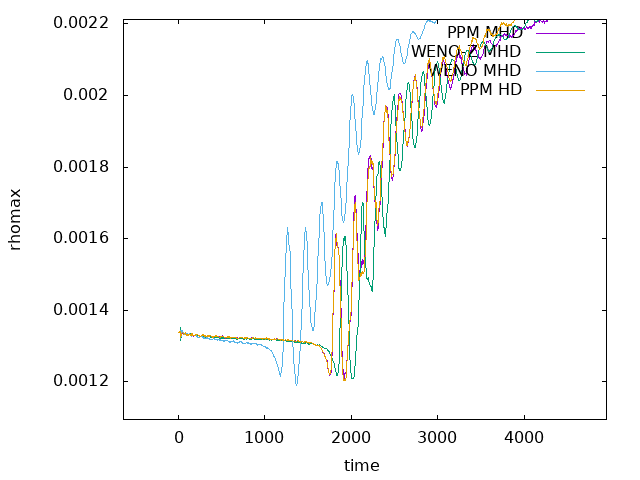
I made a minimal test of the recon method issue for the MHD code with Bvec=0. It also shows that WENO is problematic in producing consistent inspiralling behaviour (recon_comparison_mhd.png). The tested model is for M_baryon = 1.4 M_solar binary with 40km separation and dxmin=0.375, studied in Parma group's 2016 paper.
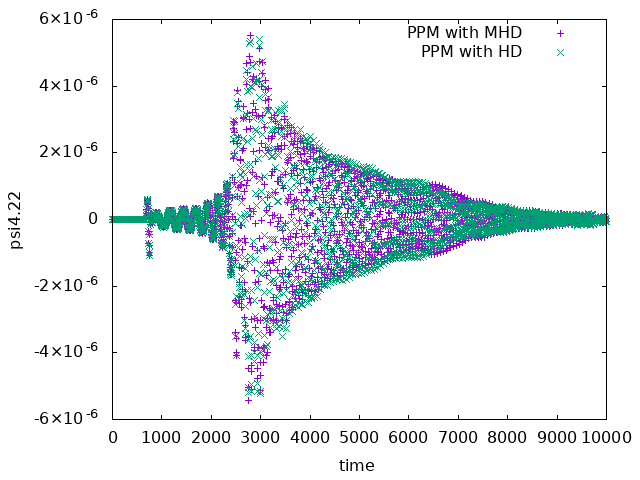
It's a totally separate issue but for your curiosity, I attached the time series of Psi4 for l=m=2. It shows a much shorter t_merger and the poster merger difference between MHD/HD. But it's somehow understandable and should be examined with higher resolutions etc.
Thanks,
Hee Il
On Tue, Jun 15, 2021 at 1:20 AM Gabriele Bozzola bozzola.gabriele@gmail.com wrote:
Hello,
two years ago I performed a convergence test of GRHydro. I found that the PPM scheme converges, but not the WENO one. Difficult to say what version of ET I used, but I'd guess the last one of 2018.
I dug up the two attached plots. This was with a piecewise polytrope, but the result is the same with a single polytrope. You can clearly see how increasing the resolution does not decrease the amplitude of the oscillation of rho in the case of WENO, but it does so in the case of PPM. The initial data is a TOV star and no magnetic fields were used. I don't have the par files anymore.
I didn't investigate much further because I use IllinoisGRMHD and it is possible that I was doing something wrong. However, this conversation is giving support to the idea that WENO might have problems.
Gabriele
On Thu, Jun 10, 2021 at 2:52 PM Hee Il Kim heeilkim@gmail.com wrote:
Thanks Roland and Maria
2021년 6월 10일 (목) 오후 11:50, Roland Haas rhaas@illinois.edu님이 작성:
Hello Hee Il,
from your email it seems that you are seeing differences between different ET releases but with the same par file.
I'm not seeing different results between Turing and Lorentz. Since they are identical, I've shown only representative plots (rhomax vs time btw). The issue is that he WENO of the ET versions do not produce the same inspiraling time with that of WENO-Z, MP5, and PPM, whereas the other three recon methods show decent coincidence for the inspiralling time.
Yet your plot seems to not show any pair of curves that only differ by the release code used.
Explained above.
If you are comparing to the runs by the Parma group (or any simulation) then you must ensure that you are comparing "apples with apples" ie you would have to run their parfiles with the current ET release (to check for a change) and also with their code (to check if the issue is compiler / cluster changes).
I'm not going to compare my current results to the Parma group runs. As you discussed in the meeting, since they used the recon codes and Con2Prim for the MHD, it might give different results. But if the differences are big even with zero B, I think it needs to be examined further in the future.
They provide their code and parfiles in:
https://einstein.pr.infn.it/svn/numrel/pub/
See "Background material" on
https://einstein.pr.infn.it/gravity/Research/BNS2016.html
which is listed on the "Additional Resources" page of:
https://docs.einsteintoolkit.org/et-docs/Additional_resources
Yours, Roland
I've been aware of it and used its grid setup. At first, I didn't follow their parfile but used my own grid amr with NSTracker. But for the comparison, I followed the parfiles there. I haven't tried to use the entire code of the Parma group. But at least I found their Lorene is different from official Lorene and ET Lorenes. I've made an ID by using their Lorene but the ID was not readable by recent ET/GRHydros.
My feeling is that GRHydro_WenoRecontruct codes need to be examined.
Thanks,
Hee Il
Hi
I'm reporting on recon_method dependency issue at least found in
Turing and
Lorentz. I've been studying BNS evolution by taking some of the Parma
group
models as references (DOI: 10.1103/PhysRevD.93.064047). But there were significant differences in merger time, t_merger. At the moment, I
will put
aside direct comparison between the GRHydro of Parma and recents ones.
What I've found is that WENO of Turing/Lorentz produces much shorter inspiraling time (See the attached figure). But WENO-Z/PPM/MP5, they
all
produce similar inspiraling time. Of course, depending on resolutions,
they
produce different merging behaviour but as shown in the figure,
higher-res
PPM matches with lower-res WENO-Z nicely, which is consistent with our expectations. I've got the identical results for both Turing and
Lorentz
versions.
I've missed recent GRHydro developments for a long time and I have no guesses for the discrepancy. I hope GRHydro developers examine this
issue
for the consistency of the recon_method. Thanks for your help in
advance.
Hee Il
-- My email is as private as my paper mail. I therefore support encrypting and signing email messages. Get my PGP key from http://pgp.mit.edu .
Users mailing list Users@einsteintoolkit.org http://lists.einsteintoolkit.org/mailman/listinfo/users
users@lists.einsteintoolkit.org
-
 Gabriele Bozzola
 -
 Hee Il Kim
 -
 Roland Haas